Leadership is easy to recognize when someone has the title, the attention, or the applause. But some of its strongest forms are revealed when no one is looking.
The five stories
Chapter 1 · Eric Allen — AWARENESS
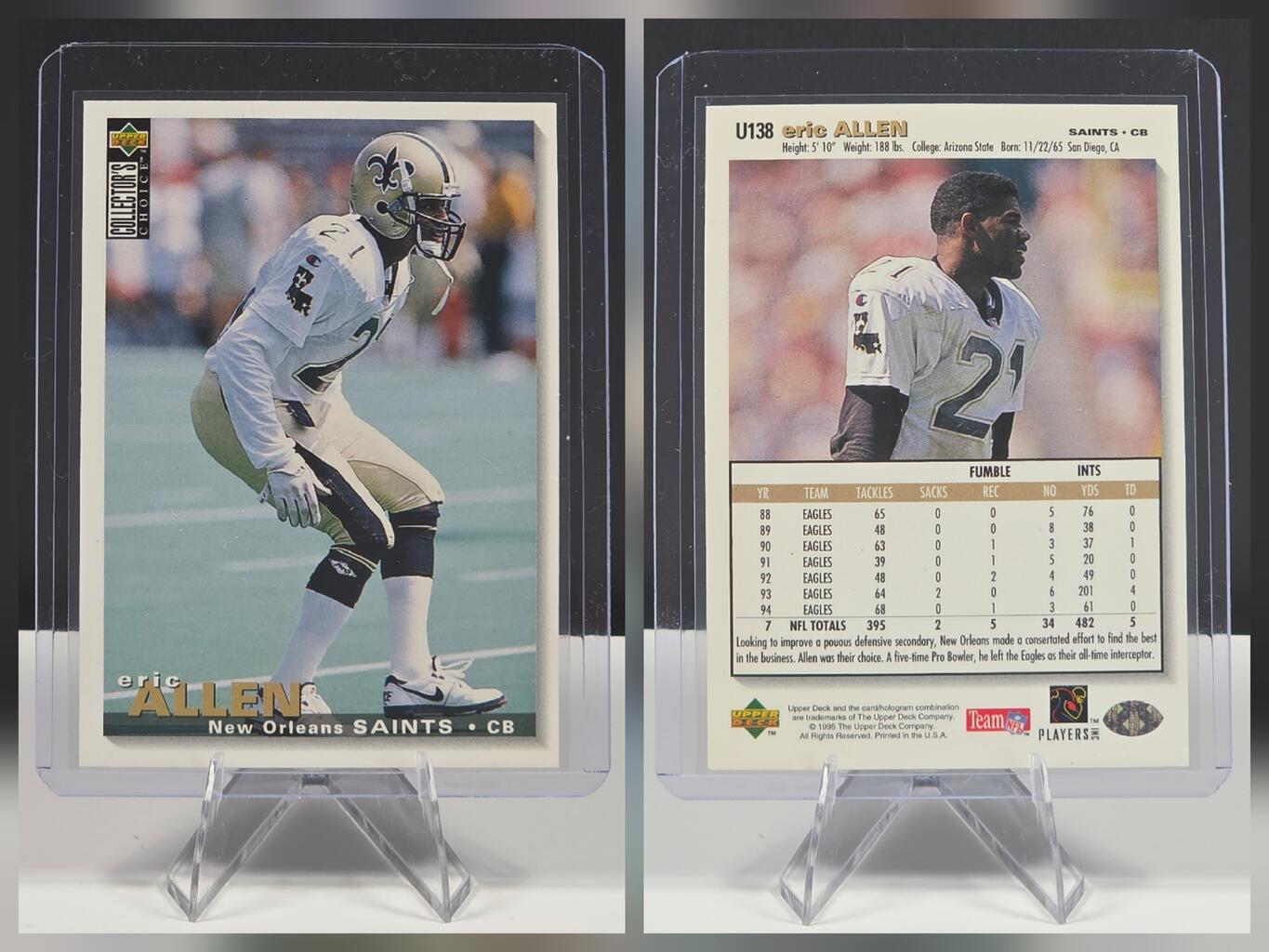
Physical Card: 1995 Upper Deck Collector’s Choice Update U138 — Eric Allen, New Orleans Saints
Some of the most important moments happen before anyone else realizes something is about to happen.
Eric Allen built his football career around that idea. A cornerback cannot simply react after a receiver makes his move. He has to study tendencies, recognize situations, and anticipate what might happen next. Allen became one of football’s best defensive backs because he learned how to see the game this way.
After starring at Arizona State, Allen entered the NFL with the Philadelphia Eagles in 1988. He developed a reputation for preparation and an ability to turn recognition into opportunity. During seven seasons in Philadelphia, he intercepted 34 passes. In 1993 alone, he returned four interceptions for touchdowns, tying the NFL single-season record at the time.
But awareness mattered beyond knowing where a quarterback might throw.
Allen eventually had to recognize when circumstances had changed. After Philadelphia, he joined the New Orleans Saints—the team represented by this card. Three seasons later, he moved to Oakland. New teams brought different systems, teammates, expectations, and stages of life.
Allen kept adjusting.
His career lasted fourteen NFL seasons. Even at age 35, he intercepted six passes for Oakland in 2000 and returned three for touchdowns. He retired after the 2001 season with 54 career interceptions and eight interception-return touchdowns.
Then the game changed again.
Allen carried his football knowledge into broadcasting, using years of studying the game to help others understand it. The player who once anticipated what quarterbacks and receivers were about to do found another purpose for the awareness he had developed on the field.
Recognition continued long after his final game. Philadelphia inducted him into the Eagles Hall of Fame in 2011. Then, after a long wait, Allen was inducted into the Pro Football Hall of Fame in 2025.
His journey makes awareness bigger than anticipation on a football field. It is recognizing change, understanding what experience has taught you, and finding another way to use what you know.
👀 LOOK AT THE CARD AGAIN
Allen is pictured with New Orleans rather than Philadelphia, where he first became a star.
Look closer.
The uniform captures a transition. One chapter had changed, but what Allen had learned traveled with him—to another team, another stage of life, and eventually another career.
💎 HIDDEN GEM — AWARENESS
Sometimes experience is not knowing exactly what will happen. It is learning what to notice before it does.
💭 HIYASAT REFLECTION
Awareness grows when experience teaches us where to look. Circumstances may change, but what we have learned can still guide what comes next.
Chapter 2 · Gary Clark — TOUGHNESS
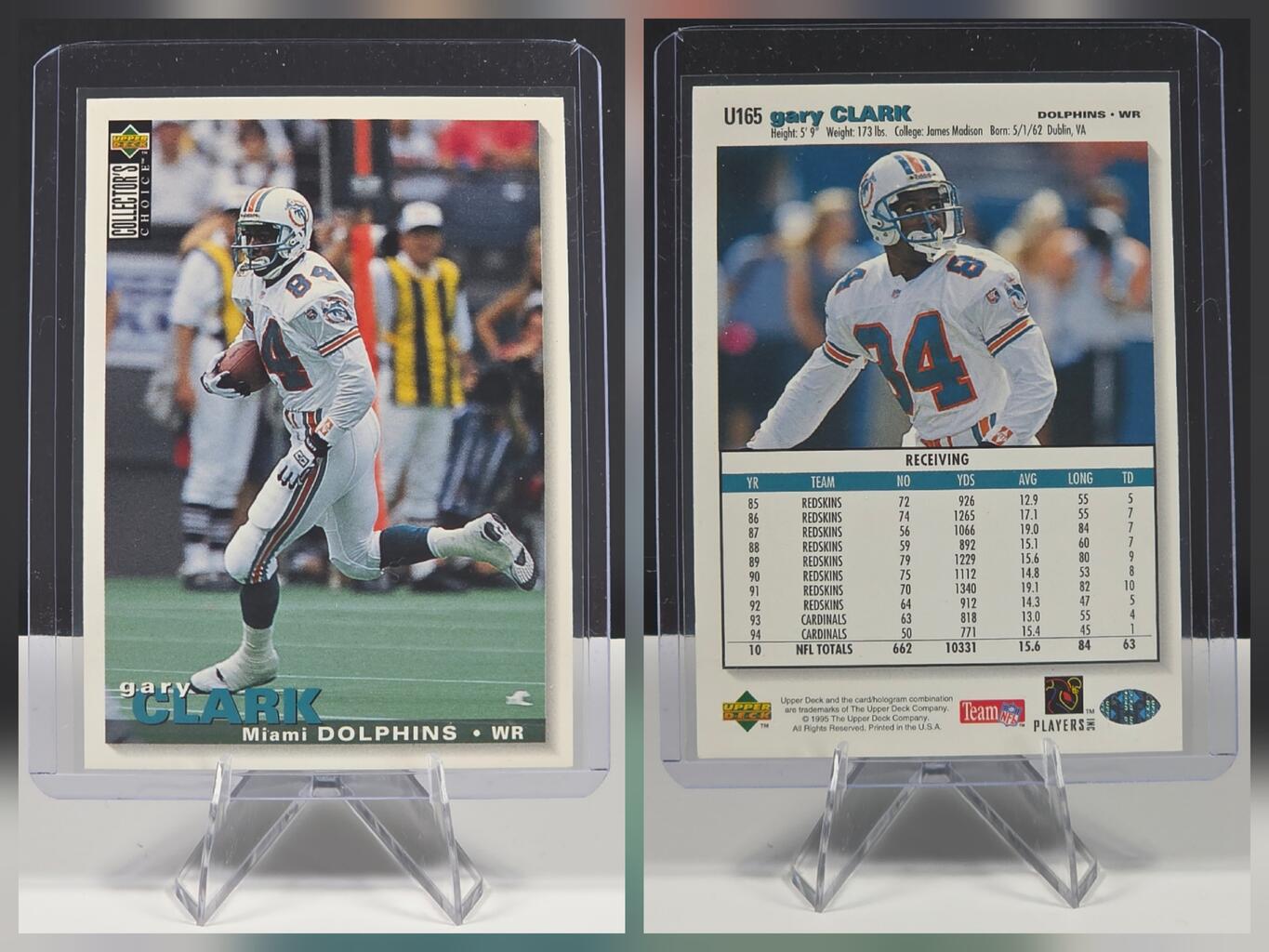
Physical Card: 1995 Upper Deck Collector’s Choice Update #U165 — Gary Clark, Miami Dolphins
Toughness is easy to recognize when someone is winning. It becomes more revealing when something goes wrong.
Gary Clark spent much of his football life overcoming reasons people might have underestimated him. At about 5-foot-9, he did not have the size expected of an intimidating NFL receiver. What he developed instead was speed, competitiveness, preparation, and an unwillingness to stay down when a moment went against him.
Clark began professionally in the USFL before joining Washington in 1985. He quickly became part of an offense filled with accomplished players. Over the years, he earned four Pro Bowl selections, surpassed 1,000 receiving yards five times, and helped Washington win two Super Bowls.
But one of the most revealing moments of his career was a play he did not make.
In the 1986 NFC Championship Game against the New York Giants, Clark got behind the defense with a chance for a touchdown. The pass reached his hands.
He dropped it.
Washington was shut out, and Clark carried the mistake with him. He later spoke openly about the play rather than pretending it had never happened. The disappointment became something he could learn from instead of something he needed to hide.
A year later, Clark was back in the NFC Championship Game. This time, his touchdown reception provided the winning points that sent Washington to Super Bowl XXII. His career continued through another championship season, thousands of receiving yards, and years as one of the league’s most productive receivers.
Eventually, the uniform changed too. Clark played for Phoenix and then Miami—the team pictured on this card—near the end of his career. He retired with 699 receptions, 10,856 receiving yards, and 65 touchdowns.
Football ended, but Clark kept building. He moved into business and media and remained connected to the Washington football community. Even during his playing years, he had created a youth sports camp after reading about a teenager caught carrying drugs, using his visibility to encourage young people toward a different path.
That makes toughness more than enduring hits or playing through pain.
Sometimes toughness is being willing to remember the mistake, learn from it, and still believe another opportunity will come.
👀 LOOK AT THE CARD AGAIN
Clark is wearing Miami colors, far removed from the Washington uniform most associated with his success.
Look closer.
The card captures a late chapter. The championships were behind him, but the qualities that helped create them were still his to carry.
💎 HIDDEN GEM — TOUGHNESS
A difficult moment can become part of your story without becoming the end of it.
💭 HIYASAT REFLECTION
Toughness does not erase disappointment. It allows us to carry the lesson forward without carrying the belief that one failure defines who we are.
Chapter 3 · Ruben Brown — RELIABILITY
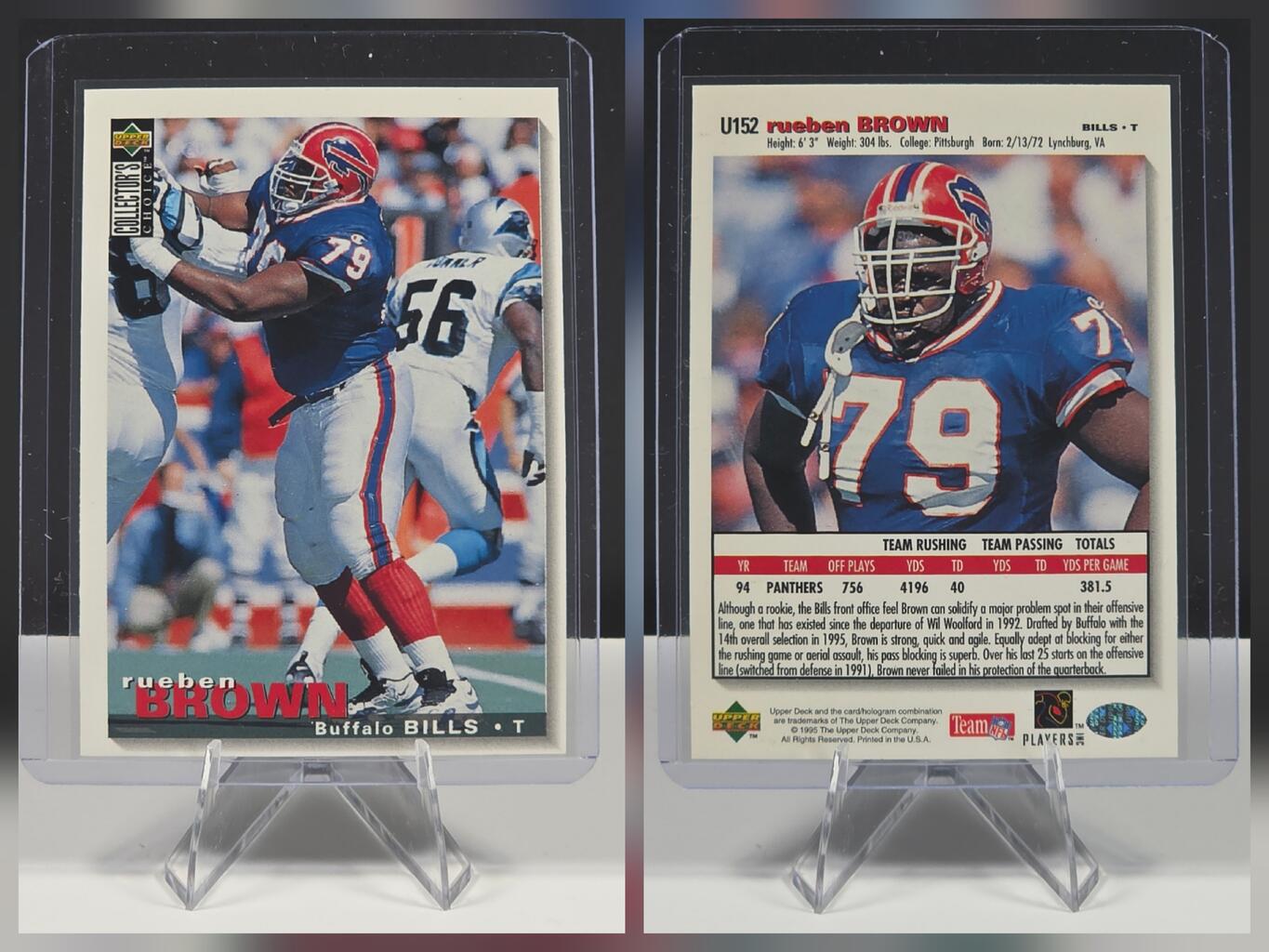
Physical Card: 1995 Upper Deck Collector’s Choice Update #U152 — Ruben Brown, Buffalo Bills — Rookie Card
Some people become important not because they demand attention, but because others learn they can depend on them.
Ruben Brown built a football career in a position where reliability mattered more than recognition. After beginning college as a defensive lineman, he moved to offensive tackle at Pittsburgh. The change worked. Brown became an All-American, and in 1995 the Buffalo Bills selected him 14th overall in the NFL Draft.
Buffalo moved him to guard, and Brown immediately became a starter.
Then he kept showing up.
From 1996 through 2003, Brown was selected to eight consecutive Pro Bowls with the Bills. After joining the Chicago Bears, he eventually earned a ninth and helped Chicago reach Super Bowl XLI. Across his NFL career, Brown played 181 regular-season games.
He started every one of them.
For an offensive lineman, that consistency carries special meaning. Much of the job happens away from the football. Success often means someone else has enough time to throw, enough space to run, or enough protection to make the play people remember.
But Brown’s reliability was not limited to Sundays.
During his Buffalo years, he became deeply involved in the community and was named the Bills’ Walter Payton Man of the Year three times. In 2001, he established the Ruben Brown Foundation to support organizations helping young people through athletics, education, and cultural programs.
When football ended, that commitment remained.
Brown continued his charity work and became involved in radio and television in Western New York. Buffalo had become more than the city where he played. It became home—a community where he raised his family and continued contributing after the uniform was gone.
Recognition followed. Brown entered the Greater Buffalo Sports Hall of Fame and, in 2015, the College Football Hall of Fame.
His story gives reliability a larger meaning.
It is not simply being available when things are easy. It is building a pattern of showing up until people understand that your presence means something. On a football line, in a community, or in the lives of others, trust is often built the same way: repeatedly.
👀 LOOK AT THE CARD AGAIN
This rookie card captures Brown near the beginning, before the nine Pro Bowls and years of community recognition.
Look closer.
Nothing on the card can show 181 future starts. Reliability could only be revealed one game, one responsibility, and one decision at a time.
💎 HIDDEN GEM — RELIABILITY
Trust is rarely built in one remarkable moment. It grows through the ordinary moments when we keep showing up.
💭 HIYASAT REFLECTION
Being dependable may never attract the most attention. But over time, consistency becomes its own kind of legacy: people remember who they could count on.
Chapter 4 · Mark Stepnoski — CONVICTION
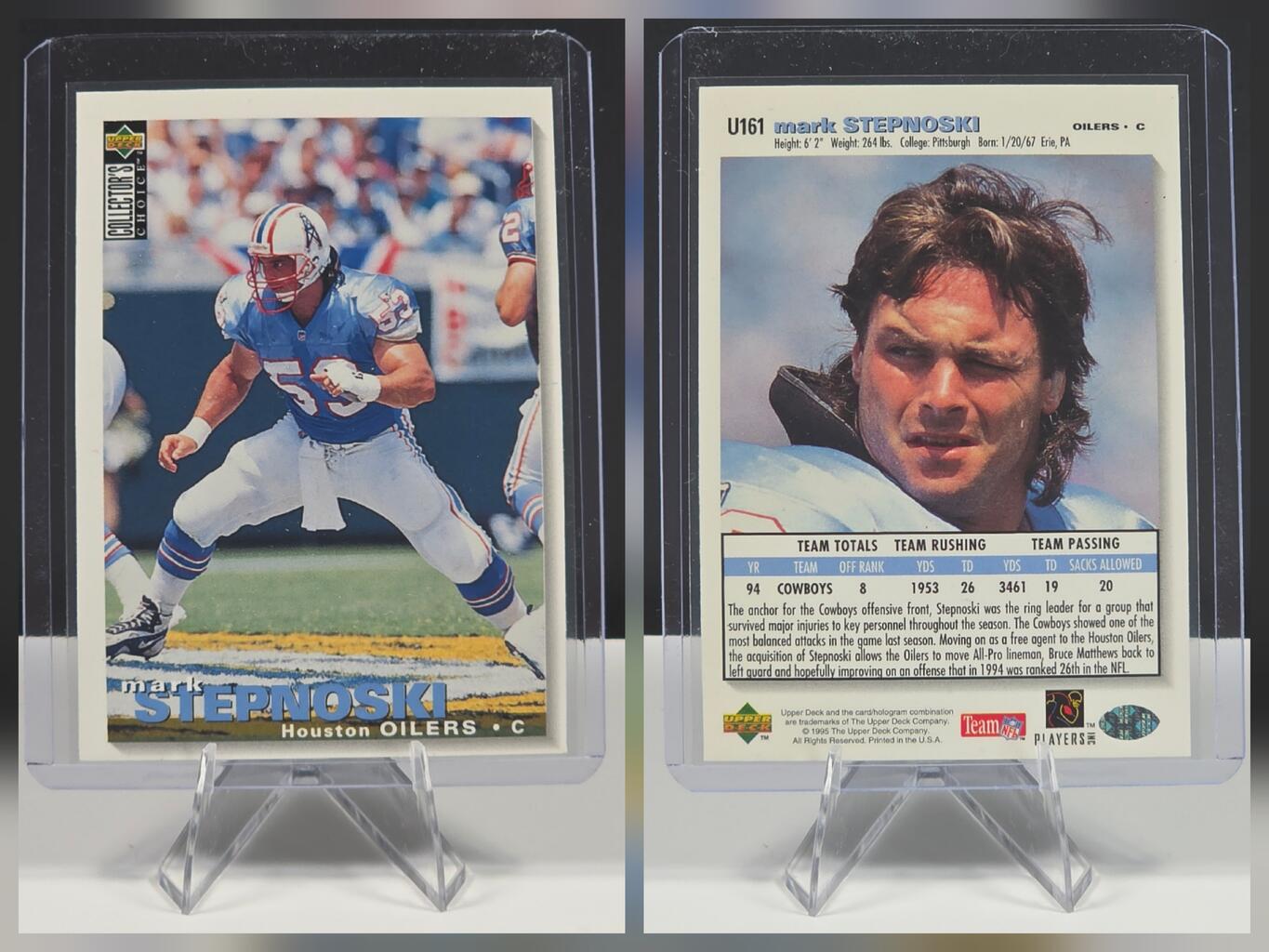
Physical Card: 1995 Upper Deck Collector’s Choice Update #U161 — Mark Stepnoski, Houston Oilers
Conviction often begins quietly. It is knowing what matters to you before anyone else agrees.
Mark Stepnoski spent much of his football life succeeding through intelligence and discipline. At the University of Pittsburgh, he became a consensus All-American while also earning Academic All-American honors twice. Dallas selected him in the third round of the 1989 NFL Draft and eventually moved him from guard to center.
Stepnoski was not built like the biggest linemen around him. At roughly 6-foot-2 and 265 pounds, he often faced defenders who outweighed him. He learned to rely on technique, quickness, preparation, and an understanding of leverage.
It worked.
Stepnoski became the center of the powerful Dallas offensive line that helped protect Troy Aikman and create running lanes for Emmitt Smith. He earned three straight Pro Bowl selections with Dallas and was part of two Super Bowl championship teams.
Then he made a significant change.
After the 1994 season, Stepnoski left the Cowboys and signed with the Houston Oilers. The move meant leaving a championship organization for a team beginning a different chapter. Yet his performance followed him. He started all 16 games in 1995 and earned another Pro Bowl selection, then returned to the Pro Bowl again the following season.
The card in this exhibition captures that transition.
Stepnoski eventually returned to Dallas in 1999 and finished his career there after the 2001 season. Across thirteen NFL seasons, he became a five-time Pro Bowler and was named to the NFL’s 1990s All-Decade Team.
After football, conviction became visible in another way.
Stepnoski publicly supported changing marijuana laws and became involved with organizations advocating reform. He served as president of the Texas chapter of NORML and spoke openly about a position that could invite disagreement.
HIYASAT does not need to decide whether his position was right or wrong to recognize what his story reveals. Conviction is not agreement. It is the willingness to examine what you believe, make your own choice, and accept that others may see things differently.
Stepnoski later moved to Vancouver, carrying his life beyond the game that first made his name known.
👀 LOOK AT THE CARD AGAIN
Stepnoski is not wearing the Dallas uniform associated with his championships.
Look closer.
The Houston uniform captures someone who had already experienced success but was willing to enter a different situation and prove that his ability belonged to him—not merely to the team around him.
💎 HIDDEN GEM — CONVICTION
Conviction is not following the loudest voice. It is knowing why you chose your own direction.
💭 HIYASAT REFLECTION
We will not always be surrounded by people who agree with us. What matters is whether our choices come from thoughtful examination rather than simply following the crowd.
Chapter 5 · Ronnie Lott — EXAMPLE
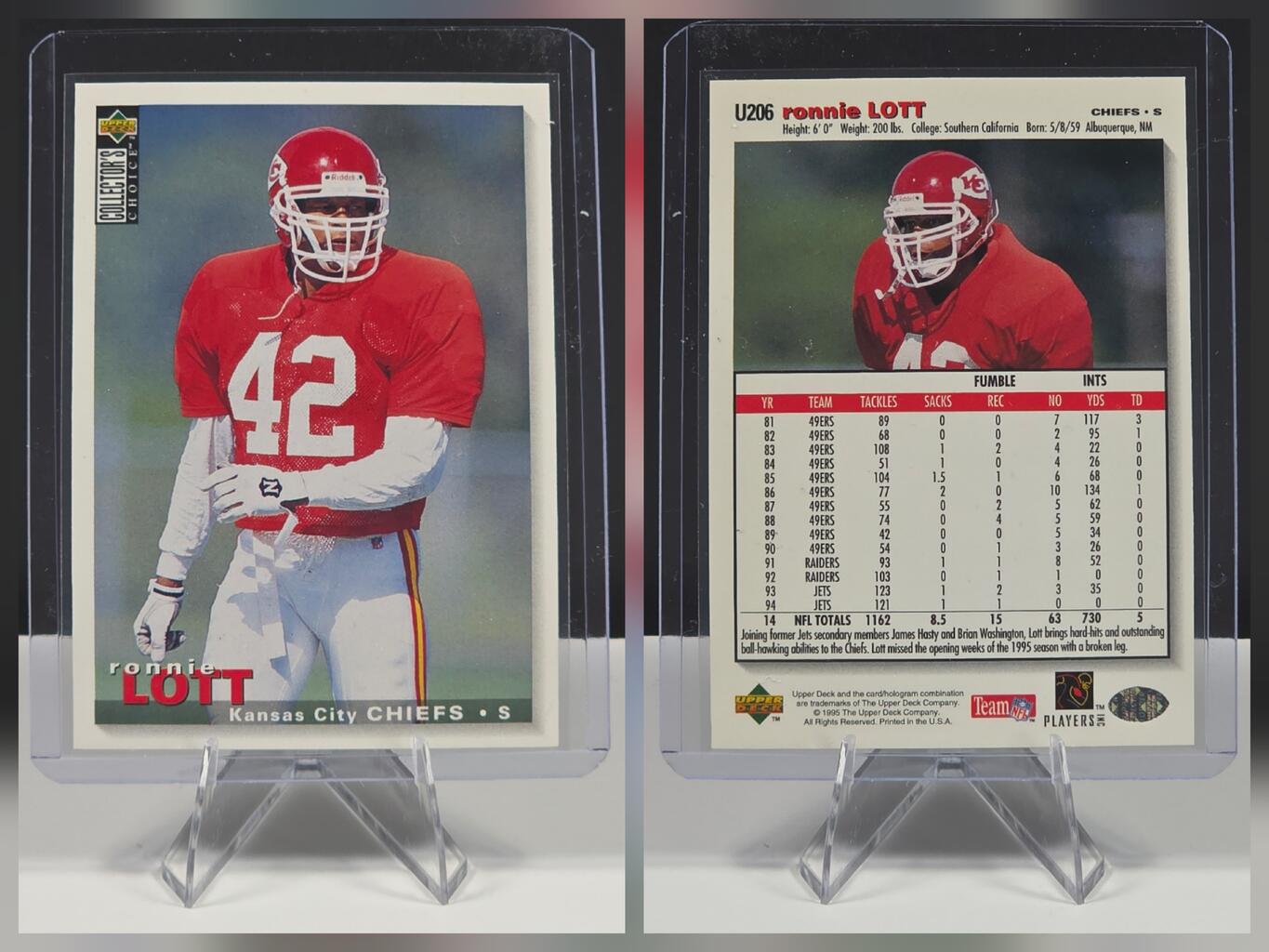
Physical Card: 1995 Upper Deck Collector’s Choice Update #U206 — Ronnie Lott, Kansas City Chiefs
Leadership can begin with words. Eventually, the strongest form becomes something other people can see for themselves.
Ronnie Lott built his football reputation through the way he played. San Francisco selected him eighth overall in the 1981 NFL Draft, and he immediately became part of a young defense that helped the 49ers win Super Bowl XVI.
That championship was only the beginning.
Lott became known for physical courage, preparation, and an intensity that established a standard for those around him. He could play cornerback, free safety, or strong safety. Across fourteen NFL seasons, he earned ten Pro Bowl selections, recorded 63 interceptions, and helped San Francisco win four Super Bowls.
But an example matters because other people can carry something from it.
After ten seasons with San Francisco, Lott continued with the Los Angeles Raiders and New York Jets. By then, his value extended beyond individual statistics. He brought experience, expectations, and an understanding of what winning demanded.
His playing career ended after the 1994 season, but his influence did not.
Even before leaving football, Lott and his wife, Karen, had founded All Stars Helping Kids in 1989. The organization grew into a long-term effort supporting underserved young people and community organizations. Football had given Lott visibility. He chose to use some of that visibility for people who might otherwise receive very little.
He also entered business after football, becoming an entrepreneur and investor and serving on corporate and nonprofit boards. In 2000, his football legacy received its highest individual recognition when he entered the Pro Football Hall of Fame.
Those chapters make EXAMPLE larger than the image of a hard-hitting safety.
An example is what remains when achievement is no longer enough by itself. It is the standard someone demonstrates repeatedly—in competition, in work, in service, and in the way success is used after the applause fades.
👀 LOOK AT THE CARD AGAIN
Something about this card is unusual.
Lott is shown with the Kansas City Chiefs, yet his official NFL career statistics end with the New York Jets in 1994. The card captures the edge of a transition rather than another celebrated season.
Look closer.
Perhaps that makes it fitting. The football career was ending, but the example did not have to end with it.
💎 HIDDEN GEM — EXAMPLE
The greatest influence may not be what we accomplish ourselves, but what our example encourages someone else to carry forward.
💭 HIYASAT REFLECTION
Achievements eventually become memories. Example can last longer. The way we use what we have learned, earned, and been given may become the part of our story that continues through other people.